

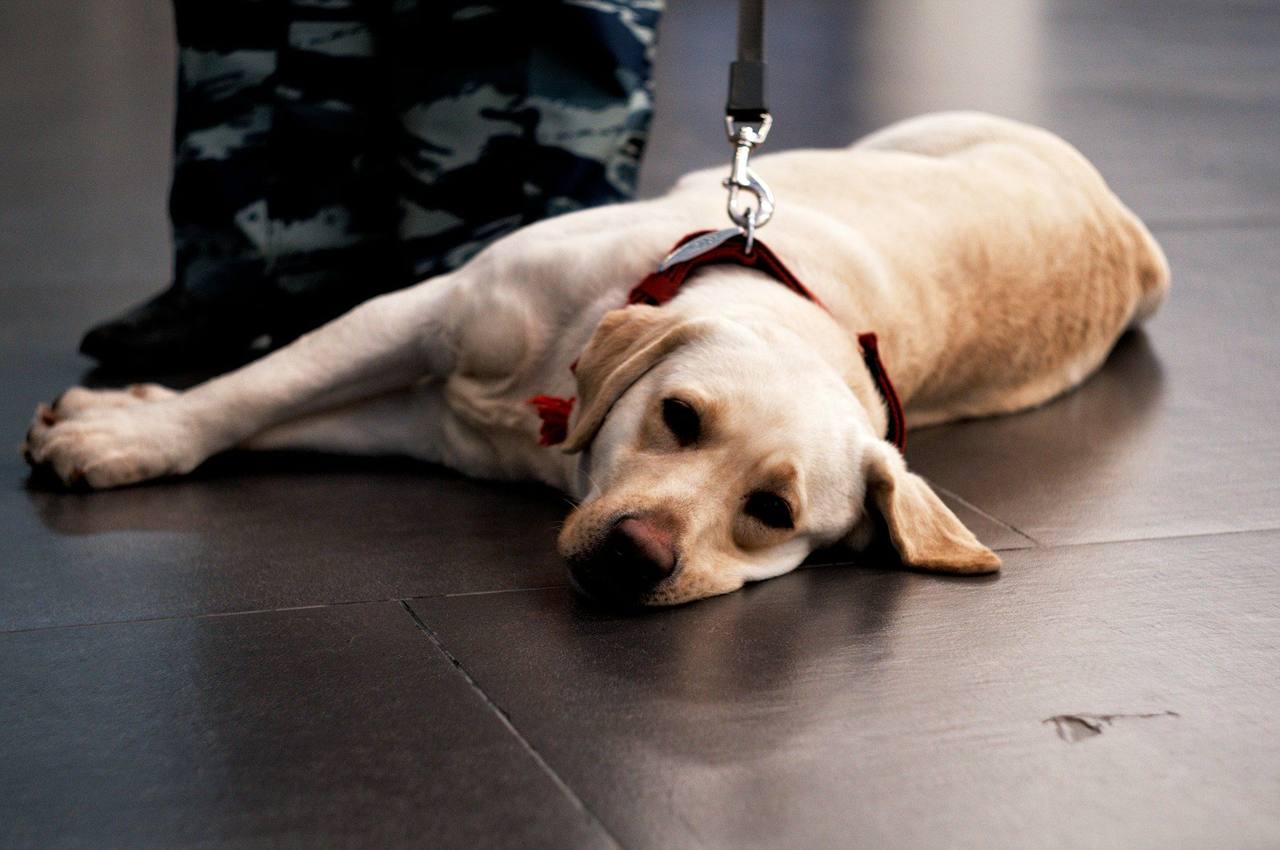
The Home Office has updated its list of explosives detection dog teams accredited for private sector work, showing 102 dog and handler pairings across 40 suppliers. The list, updated on 16 October 2026, covers teams accredited under the National Canine Training and Accreditation Scheme for the private security industry (NCTAS-P).
Three suppliers account for 44 of the 102 teams: ICTS with 21, G4S with 13 and Specialist K9’S LTD with 10. The list also includes RFA with seven, K9 Deployment with five and Ward-Security with four. The rest of the market is fragmented: 34 of the 40 suppliers have one or two teams each. By membership type, 76 teams are listed under company membership, 25 under individual membership and one as a sole trader.
Labradors and spaniels dominate
Labradors are the most common breed on the list, with 31 dogs. English springer spaniels number 30, with a further seven listed as springer spaniels, and there are 21 cocker spaniels. Crosses account for most of the rest, with five springadors and five sprockers, alongside one Malinois, one German short-haired pointer and one pointer and Labrador cross. The list records 63 male and 39 female dogs.
Accreditation applies to each specific pairing of dog and handler. Under the published NCTAS-P standard, a team holds valid accreditation only if it has passed assessment within the last 12 months, and every team must be re-accredited annually. Initial accreditation is carried out by an independent assessor listed on the NCTAS Assessor National Register. On the current list, 21 teams have accreditation expiry dates between October and December 2026.
How the scheme works
According to the Home Office, NCTAS-P was developed by the Home Office, Counter Terrorism Policing and the National Protective Security Authority, supports the government’s counter-terrorism strategy, CONTEST, and is voluntary. Its stated aim is to give operators of sites that buy explosives detection dog services confidence in the quality of those services. The standard says the National Police Chiefs’ Council mandated that all police explosives detection dog teams be trained and accredited to the police scheme, NCTAS, from 1 January 2020. A private sector version followed after Counter Terrorism Policing’s Step Change programme, set up in response to the terrorist attacks of 2017, noted the lack of a government and police recognised accreditation scheme for private providers. The standard says the performance a team needs to pass is identical under both schemes.
The list changes often. The GOV.UK page’s change history shows 16 updates so far in 2026, the previous one on 7 October. The page does not show how many teams joined or left between versions or how many teams failed assessment.
Equanine’s reading
- The accredited private market is concentrated at the top, with three firms holding 44 teams, but has a long tail of small operators. That structure leaves room for consolidation, or for subcontracting between larger firms and sole operators.
- For breeders who supply detection dog trainers, the breed mix is narrow: Labradors, spaniels and crosses between them make up 99 of the 102 dogs.
- Annual re-accreditation creates recurring demand for assessment, continuation training and handler time. The 21 renewals due before the end of 2026 give a sense of the volume.
- Venue and event operators buying detection dog services can check a named dog and handler pairing against the list before contracting.