
A study published in the Equine Veterinary Journal (EVJ) on 12 October 2026 reports that breeding stallions show measurable metabolic, hormonal and blood-cell changes across a mating season, most of which reversed after it ended. Crossref, which registers the paper’s DOI, lists it as a journal article published online on 12 October as the version of record, so it is not a preprint. Equanine could not open the article page to confirm its article type or peer-review details. It is open access under a Creative Commons Attribution 4.0 licence and followed ten stallions.
The lead author is Maria Grazia Cappai of the Department of Veterinary Medicine at the University of Sassari in Italy. Three of the five co-authors are listed with the Agency for Equine Breeding and Valorization (ASVI) of the Autonomous Region of Sardinia, in Ozieri. The funding source is not stated in the abstract or in the paper’s Crossref registration record, which lists no funder, and Equanine could not access the full text to check funding, conflicts of interest or where the stallions were kept.
What the researchers measured
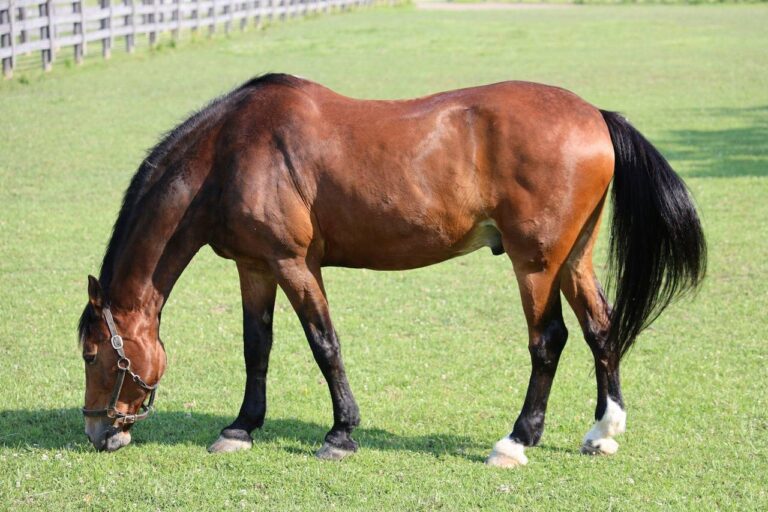
The prospective observational cohort study assessed ten clinically healthy stallions of mixed breeds, aged 8 to 22 years and weighing 496 to 625 kg, at four points: the start, middle and end of the mating season, and a period of shortening daylight afterwards. The team recorded bodyweight, body condition and muscle condition scores alongside full blood counts, plasma leptin, testosterone, catalase and two markers of energy balance.
According to the authors, bodyweight did not change significantly, but non-esterified fatty acids were raised before the season without ketonaemia, which they interpret as a subclinical negative energy balance. Muscle condition scores peaked mid-season. Leptin fell from 3.70 ng/mL at the start to 1.11 ng/mL after the season, and testosterone also fell, more sharply in stallions older than 13. White blood cell counts fell from 7.59 to 0.83 billion per litre by the end of the season, as stated in the abstract, and recovered afterwards, and one derived leucocyte ratio rose 13-fold at the end of the season.
Authors’ conclusions and limits
The authors conclude that the mating season produces subclinical metabolic adaptations and a marked but reversible fall in white cells in healthy stallions, and they argue for an integrated, biomarker-based approach to preventive medicine. These are the researchers’ findings from a small sample. The abstract does not report reproductive outcomes such as fertility rates or the number of mares covered, and it does not describe a comparison group of stallions that were not breeding.
Equanine’s reading
- Stallion health through the season underpins a stud’s covering income, so longitudinal data of this kind is of commercial interest, but ten horses studied by one university and one regional agency is a starting point, not a benchmark.
- The involvement of a public breeding agency shows how state-run breeding programmes can supply research populations that private studs rarely open up.
- Studs, insurers and veterinary groups have reason to treat the biomarker approach as a research proposal until larger studies across breeds link it to fertility outcomes.